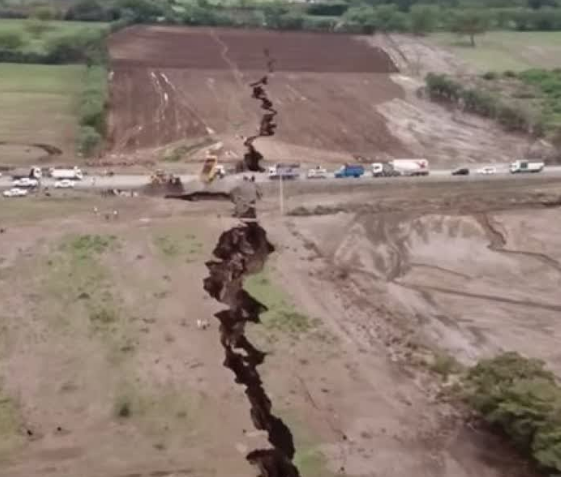
一段令人震惊的视频画面显示,巨大的裂缝将要把整个非洲大陆一分为二。
Astonishing footage shows the huge crack that is threatening to split the entire continent of Africa in two.
这一位于肯尼亚的巨大裂缝有50英尺深、65英尺宽,已经毁坏了部分奈洛比-奈良高速公路。
The massive crevice in Kenya measures 50 feet deep and 65 feet wide and has destroyed part of the Nairobi-Narok highway.
现在,研究构造板块的科学家声称,该巨大的裂缝可能会撕裂非洲。
Now, scientists who study tectonic plates are claiming the giant crack could rip Africa apart.
伦敦大学的博士后研究员露西娅·佩雷斯·迪亚兹解释了这种大陆断裂是如何发生的。
Lucia Perez Diaz, a postdoctoral researcher at the Universtiy of London, explained how this continental rupture could occur.
迪亚兹称:“东非大裂谷从北部的亚丁湾延伸到南部的津巴布韦,绵延1800多英里,将非洲板块分割成两个不均等的部分:索马里板块和努比亚板块。
Diaz said: "The East African Rift Valley stretches over 1,800 miles from the Gulf of Aden in the north towards Zimbabwe in the south, splitting the African plate into two unequal parts: the Somali and Nubian plates."
“当肯尼亚西南部突然出现大裂缝时,沿着裂谷东部分支,靠近埃塞俄比亚、肯尼亚和坦桑尼亚所出现的活动也变得明更为明显。”
“Activity along the eastern branch of the rift valley, running along Ethiopia, Kenya and Tanzania, became evident when the large crack suddenly appeared in south-western Kenya.”
这一过程被称为“大陆张裂”,需要在地球上施加巨大的力量。在地壳下面,“岩浆柱”的形成迫使地壳上升并最终分裂。
The process is known as "continental rifting" and requires huge forces to be exerted on the Earth. Underneath the crust, a "magma plume" forms forcing the crust up and eventually splitting it.
迪亚兹补充称:“最终,在数千万年的时间里,海底的扩张将沿着裂谷的整个长度范围推进。海洋将会涌入,非洲大陆则将变得更小,印度洋上将会出现一个由埃塞俄比亚和索马里部分地区组成的大岛,包括非洲之角。”
Diaz added: "Eventually, over a period of tens of millions of years, seafloor spreading will progress along the entire length of the rift. The ocean will flood in and, as a result, the African continent will become smaller and there will be a large island in the Indian Ocean composed of parts of Ethiopia and Somalia, including the Horn of Africa."
这一活跃的裂谷区正以每年几毫米的速度扩张。这意味着在大约1000万年的时间里,随着裂口继续撕裂非洲,新的海洋将会出现。
The active rift zone is spreading at a few millimeters per year. This means that in around 10 million years, a new ocean will emerge as the rip continues to tear Africa apart.