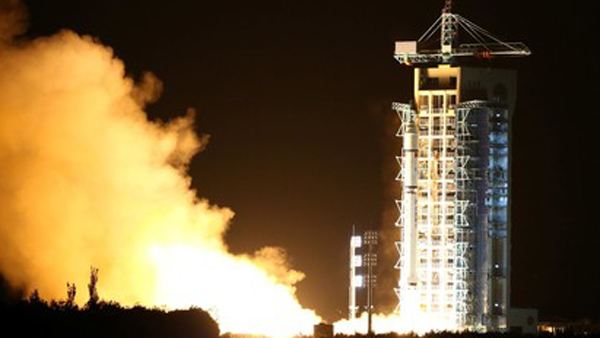
周四早上,中国发射了首个X射线太空望远镜。在中国发展可与美俄匹敌的太空计划的征程中,此举是迈出了重要一步。
China launched its first x-ray telescope Thursday morning, a significant step in the country’s race to develop a space program that can rival that of the US or Russia.
这一“硬X射线调制望远镜”(Hard X-ray Modulation Telescope,简称HXMT)由一枚在国内研制的长征四号乙(Long March-4B)运载火箭从酒泉卫星发射中心发射升空。酒泉卫星发射中心位于内蒙古,是中国第一个卫星发射场地。
The Hard X-ray Modulation Telescope (HXMT) took off from China’s Jiuquan Satellite Launch Center, the country’s first satellite launch site, located in Inner Mongolia via a domestically-developed Long March-4B rocket, writes Emily Feng in Beijing.
一旦进入轨道,该望远镜将被用于观测诸如黑洞、脉冲星和伽马射线暴等高能实体,以更好地理解它们的能量来源。
Once in orbit, the telescope will be used to observe high-energy entities like black holes, pulsars and gamma-ray bursts in order to understand more about their energy sources.
2000年,作为中国科技部(Ministry of Science and Technology)、中科院(CAS)和清华大学(Tsinghua University)的合作项目,围绕该望远镜的研制工作在北京启动。
Work on the telescope began in 2000 as a joint collaboration between China’s Ministry of Science and Technology of China, the Chinese Academy of Sciences, and Tsinghua University in Beijing.
中国在发展其雄心勃勃的空间计划方面投入了大量资源。这一空间计划试图赶超美国和俄罗斯同类计划的许多成就——比如把人类送上月球。今年4月,中国成功发射了首个货运飞船天舟一号(Tianzhou-1),以支持其刚刚建成的太空实验室。
China has poured enormous resources into developing its ambitious space program, which has sought to emulate many of the achievements of its American and Russian counterparts such as putting a man on the moon. In April, China successfully launched its first cargo spacecraft, the Tianzhou-1, to support its fledgling space lab.