马家窑文化
Majiayao Culture
这种文化的残骸1923年时在甘肃省临洮县马家窑村被首次发现,
Remains of this culture were first discovered in Majiayao Village, Lintao County, Gansu Province in 1923,
因此被命名为马家窑文化。
hence the name of Majiayao Culture.
它通常被认为是仰韶文化末期的一个分支,
It is generally considered as a local branch of Yangshao Culture in the late period;
所以同样被称为甘肃的仰韶文化。
therefore it is also known as Yangshao Culture of Gansu.
它以甘肃省的西部平原为中心,延伸至甘肃省北部,
It was centered around the West Plain of Gansu Province, stretching to the north of Gansu Province
它北至宁夏回族自治区的南部,
and the south of Ningxia Hui Minority Autonomous Region in the north,
南达甘肃省南部和四川省北部,
the southern part of Gansu Province and the north of Sichuan Province in the south,
西至河西走廊和青海省的东北部,
and reaching the Gansu Corridor and the northeast of Qinghai Province in the west
东达甘肃省东部。
and the east of Gansu Province in the east.
超过20件遗迹已被发掘。
More than 20 ruins have been unearthed.
根据相关研究,马家窑文化兴盛的时间为公元前3300年到公元前2050年。
According to relevant researches, the culture was prosperous from 3300 B.C. to 2050 B.C.
该文化的祖先使用的生产工具为石器或是一端呈锯齿状的陶制镰刀。
Among the production implements the ancestors used in Majiayao Culture were stone or pottery sickles with one end shaped like a saw.
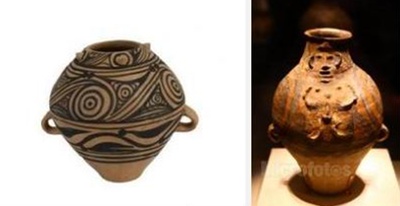
大约20%到50%的陶器为彩陶,图案丰富。
About 20% -50% of the pottery was colored pottery, profusely painted.
经济活动以农业为基础。
The economic activities were mainly based on agriculture.
鹿是人们主要的猎物,但是人们也养殖猪、狗和绵羊。
Deer was the staple prey of hunting, but pigs, dogs, sheep were also raised.
手工业涵盖石器制造业、木工、纺织、制陶业等等。
The handicraft industry included stoneware production, wood works, spinning and weaving, pottery production and so on.
美术主要采用彩陶的形式,同时还有人形或动物形状的陶器雕塑和陶制房屋模型。
Art mainly took the form of colored pottery as well as man-like or animal-like pottery sculptures and pottery house models.
很大一部分种类的陶器被刻上了符号,其中的一些骨头碎片被打破用于计算。
Quite a number of types of pottery were carved with symbols, which some pieces of bone had breached for counting.