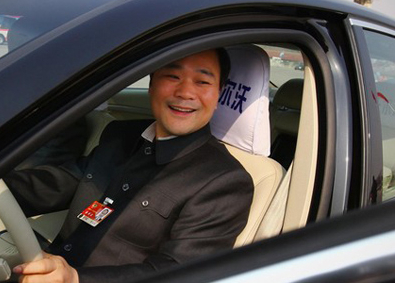
Li Shufu guffaws. The Chinese billionaire – viewed by some as his country’s answer to Henry Ford – executed one of corporate China’s most daring overseas raids when he bought Volvo Cars in 2010 from Ford.
李书福放声大笑起来。这位被一些人视为中国的亨利•福特(Henry Ford)的亿万富翁,在2010年收购了福特(Ford)旗下的沃尔沃汽车(Volvo Cars),这是中国企业最为大胆的海外收购行动之一。
But the chairman of Zhejiang Geely as well as Volvo made his start in business in much more humble circumstances. He points at the FT’s photographer clicking away in this anonymous meeting room in a Brussels hotel and says: “My first starting point was as a photographer. Of course, without such a sophisticated piece of machinery.”
但中国浙江吉利控股集团(Geely)董事长和沃尔沃董事长是在简陋得多的条件下开始创业的。他在布鲁塞尔一家酒店毫无特色的会议室里接受了英国《金融时报》的采访。他指着咔咔照相的摄影师说道:“我最开始就是搞摄影的。当然,那时没有这么复杂的设备。”
He soon showed his entrepreneurial streak, setting up his own studio after his father gave him about Rmb100 ($16). But his “very cheap camera” was no longer any good. So Mr Li built his own “rather professional camera” as well as all the lighting, furniture and backdrops in the studio.
他很快就表现出创业倾向——在父亲给了他大约100元人民币(合16美元)之后,他开了一家自己的照相馆。但他的“非常廉价的相机”满足不了需要,因此李书福制造了自己“相当专业的相机”以及照相馆里所有的照明设备、家具和背景幕布。
That mixture of engineering and entrepreneurial drive has propelled the 50-year-old Mr Li to become one of the figureheads of private Chinese industry. Geely was the first non-state-owned carmaker when it began in 1997, and had revenues of Rmb29bn ($4.7bn) last year (Volvo had sales of SKr122bn, or $19bn). Questions still remain as to whether his bold purchase of the Swedish carmaker will pay off.
这种工程悟性加创业精神推动今年50岁的李书福成为中国民营企业的领军人物之一。他于1997年创办的吉利集团是中国第一家民营汽车制造企业,去年收入达290亿元人民币(合47亿美元)——沃尔沃实现销售收入1220亿瑞士法郎,合190亿美元。至于他收购沃尔沃这家瑞典企业的大胆举措会否带来回报,仍有一些悬而未决的问题。
But for Mr Li – who also owns Manganese Bronze, the maker of black London taxis – the journey to being a carmaker was a long one. After photography, he made his initial foray into industry, and a familiar pattern soon established itself.
但是,对旗下还拥有伦敦黑色出租车生产商——锰铜控股公司(Manganese Bronze)的李书福而言,踏入汽车制造业是一个漫长的过程。在离开摄影行业之后,他首次涉足工业,很快展现出一种熟悉的模式。
First, he spots an opportunity from a previous experience: in this case, the extraction of silver and gold from abandoned machinery, drawing on the knowledge he gained from developing photographs.
首先,他从以往的经历发现一个机会:他利用从冲洗胶片中获得的知识,从废弃机械中提取金银。
The jovial Mr Li – who writes poems in his spare time – is laughing again as he explains how increased competition in this niche forced him to move on. “Getting silver and gold out of junk machinery was quick to be learnt by others,” he says, speaking through a translator.
乐呵呵的李书福喜欢在业余时间写诗。他在解释竞争加剧迫使他退出这一缝隙市场时再次大笑起来。他通过翻译表示:“其他人很快就学会了从废旧机械中提取金银。”
The story soon repeated itself in a new industry. Aged 23, he moved on to designing and manufacturing parts for fridges and soon was making the entire appliance. He set up a company called Geely, similar to the Chinese word for “lucky”. To more chuckles, he recalls how the entry of more local players into this market drove him out again. The Chinese are “quick learners and quick followers”.
同样的一幕很快出现在另一个行业。他在23岁的时候进入电冰箱配件设计和制造领域,并很快升级到整机生产。他创建了一家名为“吉利”的公司——在中文中,吉利是幸运的意思。当他回忆起本土企业纷纷涌入这个市场再次迫使他退出时,他又笑了。中国人“擅长学习和模仿”。
Due to these setbacks, as well as the Tiananmen Square massacre in 1989, Mr Li decided “maybe it is a good time to have a break” and handed his business over to the local government, before heading to university.
由于这些挫折,再加上1989年天安门广场事件,李书福觉得“或许是时候休息一段时间了”,于是他将企业交给当地政府,自己去上了大学。
Several years of studies did little to alter the cycle of Mr Li’s businesses: early adoption, a rash of copiers, a move into new territory. So it proved with a construction business, part of which he still owns today.
几年的学习没有怎么改变李书福的创业周期:率先进入某一行,然后模仿者一拥而上,于是转战新的行业。李书福仍持有部分股权的一家建筑企业就是一个例证。
Then, in 1993, he launched the first private Chinese company to make motorcycles. “Again: very popular, very successful and a lot who follow,” he says, adding that some of the competition became “vicious in nature”.
接着在1993年,他创办了中国第一家制造摩托车的民营企业。他说:“还是老套路,产品非常受欢迎,企业取得了极大的成功,然后出现了大量的模仿者。”他补充说,有些竞争“在性质上变得具有恶意”。
His final leap was into the car business. Mr Li, dressed in a blue suit with a Geely badge on his lapel, explains the attraction: “I believe the auto business is a highly comprehensive and complicated business. It’s not that easy for people simply to enter and ruin the whole thing.”
他的最后一个跳跃是进入汽车行业。身穿蓝色西装、翻领上别着一个吉利徽章的李书福解释了汽车行业的吸引力:“我认为汽车是一项高度全面和复杂的业务。人们无法轻易进入这一行并糟蹋整个格局。”
From the beginning he planned for the long term. “I believe the auto industry is a competition of human resources, competition of funding, competition of technology and the competition is international. So the key in all these [things] is people.” So he set up a university and technical schools to “supply the production base that we are establishing”.
从一开始他就着眼于长远。“我认为汽车行业是人力资源的竞争、融资的竞争、技术的竞争,而且这些竞争是在国际舞台上展开的。因此这一切的关键是人才。”于是他创办了一所大学和若干技术学校,向“我们正在创建的生产基地输送人才”。
But its early cars were far from a success. Despite rolling off the production line on August 8 – the luckiest day of the year in China – in 1998, the cars were so “rudimentary” Mr Li refused to sell them. “We scrapped them all and OK, that’s not good enough,” he says.
不过,早期生产的轿车远远算不上成功。头一批轿车于1998年8月8日下线,尽管这一日期在中国被视为最幸运的一天,但李书福因这批轿车太“低劣”而不肯将其出售。他说:“我们将这批汽车全部报废。没错,它们不够好。”
A second batch was scrapped too, and a third was “very unsatisfactory”. Similarly, a second factory in Ningbo in 2000 produced “very poor product, poor quality”.
第二批轿车也同样报废,第三批则“很难让人满意”。与此类似,位于宁波的第二家工厂2000年也生产了“很糟糕的产品,质量很差”。
The turning point came about through China’s application to join the World Trade Organisation and its concomitant promise to open up its industries. Mr Li no longer had to sub-license car design and production from another company, he could now do it himself. The Free Cruiser, based on a design by South Korea’s Daewoo, was started in 2002 and became one of the first Chinese cars to be displayed at an international show.
事情的转机来自中国申请加入世界贸易组织(WTO),以及随之而来的产业开放承诺。李书福再也不用把轿车设计和制造挂靠在其他企业,他现在可以自己申请许可证了。2002年,吉利推出了基于韩国大宇(Daewoo)设计的“自由舰”(Free Cruiser),该款车型成为首批在国际车展上展出的中国轿车之一。
In a demonstration of his self-confidence, Mr Li says he was already thinking about Volvo in 2002 – even without having had a successful model himself. Citing his “gut feeling”, he says: “I just felt that with Ford owning all these brands, at some point it could give us an opportunity to get one of them, and Volvo was my favourite.”
突显其自信的一个迹象是,李书福表示,他在2002年就在动沃尔沃的脑筋了——尽管当时他还没有自己的成功车型。他谈到自己的这种“直觉”,称:“我就是觉得福特旗下拥有这么多品牌,总有一天它会让我们有机会买到一个,而沃尔沃是我最喜欢的一个。”
It took eight years for his dream to come to fruition and even now some in the industry wonder if he has bitten off more than he can chew. “Volvo isn’t in the same league as BMW, Audi or Mercedes. I wonder if a Chinese carmaker can really turn it round,” says one German executive.
他的梦想用了8年时间才结出硕果,然而即便是现在,仍有部分业内人士怀疑他的胃口是否超出了消化能力。一位德国高管表示:“沃尔沃与宝马(BMW)、奥迪(Audi)或奔驰(Mercedes)不一样,我怀疑一家中国汽车制造商能否真正扭转它的局面。”
Hakan Samuelsson, Volvo’s chief executive, says the Swedish group has prospered under Geely’s ownership thanks to the stability and investments it has brought. “We have a very good relationship,” he says of Mr Li. “He also plays his role professionally: he has no ambition to micromanage this company.”
沃尔沃首席执行官汉肯·塞缪尔森(Håkan Samuelsson)表示,得益于吉利收购所带来的稳定性和相关投资,这家瑞典汽车集团已开始走上正轨。在提到李书福时,他表示:“我们的关系非常好。他非常专业地扮演着自己的角色:他无意对这家企业进行微观管理。”
For his part, Mr Li says that any doubt of the wisdom of such a big Chinese acquisition overseas is “evaporating”. Instead, he says the biggest pressure is in increasing Geely’s and Volvo’s combined competitiveness.
李书福则表示,对于如此大规模海外收购是否明智的任何怀疑“都在消失之中”。他表示,最大的压力在于提高吉利和沃尔沃共同的竞争力。
Mr Li is far from uncritical of Volvo. He believes there is much more the Swedish group could do in communication and marketing, particularly of its vaunted reputation for safety, a big asset in China. Mr Samuelsson’s predecessor as chief executive was abruptly ejected amid boardroom disputes. Reports of tensions persist, particularly over how to adapt Volvo’s somewhat staid image to the showy tastes of Chinese consumers.
对于沃尔沃,李书福并不吝于批评。他认为这家瑞典集团在沟通和营销上还有许多不足,特别是在该公司引以为傲的安全口碑方面,这在中国可是一大资产。塞缪尔森的前任在董事会的争端中突然出局。有关紧张气氛的报道一再出现,尤其是围绕沃尔沃有些保守的形象如何迎合中国消费者的炫耀品位。
Mr Li himself hints at this, saying: “Because of a lapse of investment in product development over the years in previous ownership, we do see a reflection of lack of modernisation of Scandinavian design.” But he quickly adds that the first new model developed with Geely’s money – the latest version of the XC90 SUV, out later this year – will offer the requisite modern take.
李书福本人也暗示存在这个问题,他说:“由于上一个东家在产品开发上多年投资不足,我们确实看到北欧设计缺乏现代化的问题。”不过他很快补充说,用吉利资金开发的首款新车型将提供必要的现代感。这一新车型是XC90 SUV(运动型多功能车)的最新版,将在今年晚些时候推出。
Talking about Volvo’s brand and what he sees as its respect for the environment and human beings, he stresses that his investment is for the long term. The brand’s image is in tune with the way in which the world is developing, he argues.
在谈到沃尔沃这个品牌以及他眼中沃尔沃对环境和人文的重视时,李书福强调他的投资是长期投资。他辩称,沃尔沃的品牌形象顺应了世界的发展变化。
“Particularly in China, I think a lot of people start to realise: OK, what are the things that they truly should value? That’s something that fits perfectly well with what Volvo is offering.”
“特别是在中国,我认为许多人正开始意识到:他们真正应该看重的是什么?那恰恰是沃尔沃在提供的东西。”